Quantum Computing Explained Like You’re Five: Basics, Breakthroughs, and Beyond
Quantum Computing Explained Like You’re Five: Basics, Breakthroughs, and Beyond
Ever tried flipping a coin and wondered what would happen if it could be heads and tails at the same time? Welcome to the mind-bending world of quantum computing.
What Even Is Quantum Computing?
Imagine your regular computer is a very fast and clever librarian. It sorts through books one at a time—really quickly—but still, one by one. Now, imagine you had a magical librarian who could read **every book in the library at the same time**. That’s the magic quantum computers promise.
Quantum computing isn’t just a faster version of your laptop. It’s an entirely different way of thinking about how computers process information, based on the strange rules of **quantum mechanics**—the same science that explains atoms, photons, and the tiny quirks of nature.
🧠 Visual 1: Bits vs Qubits

Image: Taoufik AMRI, Public domain via Wikimedia Commons
Quantum Basics, Explained Like You’re Five
1. Bits vs. Qubits
Your current computer thinks in bits: 0s and 1s. A quantum computer thinks in qubits: they can be 0, 1, or both at the same time thanks to a magical rule called superposition.
2. Superposition
Think of a spinning coin. While it’s in the air, it’s not just heads or tails—it’s kind of both. Only when it lands (i.e., when you measure it) does it “decide” what it is. That’s superposition.
3. Entanglement
Now take two spinning coins. If they’re entangled, the moment one lands on heads, the other automatically becomes tails—no matter how far apart they are. It’s like spooky teamwork between particles.
4. Measurement
In quantum computing, measuring something changes it. When you peek at a qubit to check its value, its magical state collapses into a plain old 0 or 1.
Why Quantum Computing Is a Big Deal
Quantum computers can solve certain problems way faster than classical computers. These include:
- Breaking encryption (dangerous but real)
- Simulating molecules (great for medicine and materials)
- Optimizing complex systems (e.g., logistics, finance)
🧠 Visual 2: Classical vs Quantum Comparison Table
| Task | Classical Computer | Quantum Computer |
|---|---|---|
| Searching a large database | One item at a time | All items at once |
| Simulating chemistry | Approximation models | Exact atomic simulation |
| Breaking RSA encryption | Millions of years | Potentially hours |
Where Are We Today? (2024–2025)
Here’s what’s happening in the quantum world:
- IBM has 433-qubit systems and roadmaps for 1000+ qubit devices.
- Google made headlines with “quantum supremacy” in 2019.
- Startups like Rigetti, IonQ, and PsiQuantum are pushing hardware boundaries.
🧠 Visual 3: Quantum Industry Players
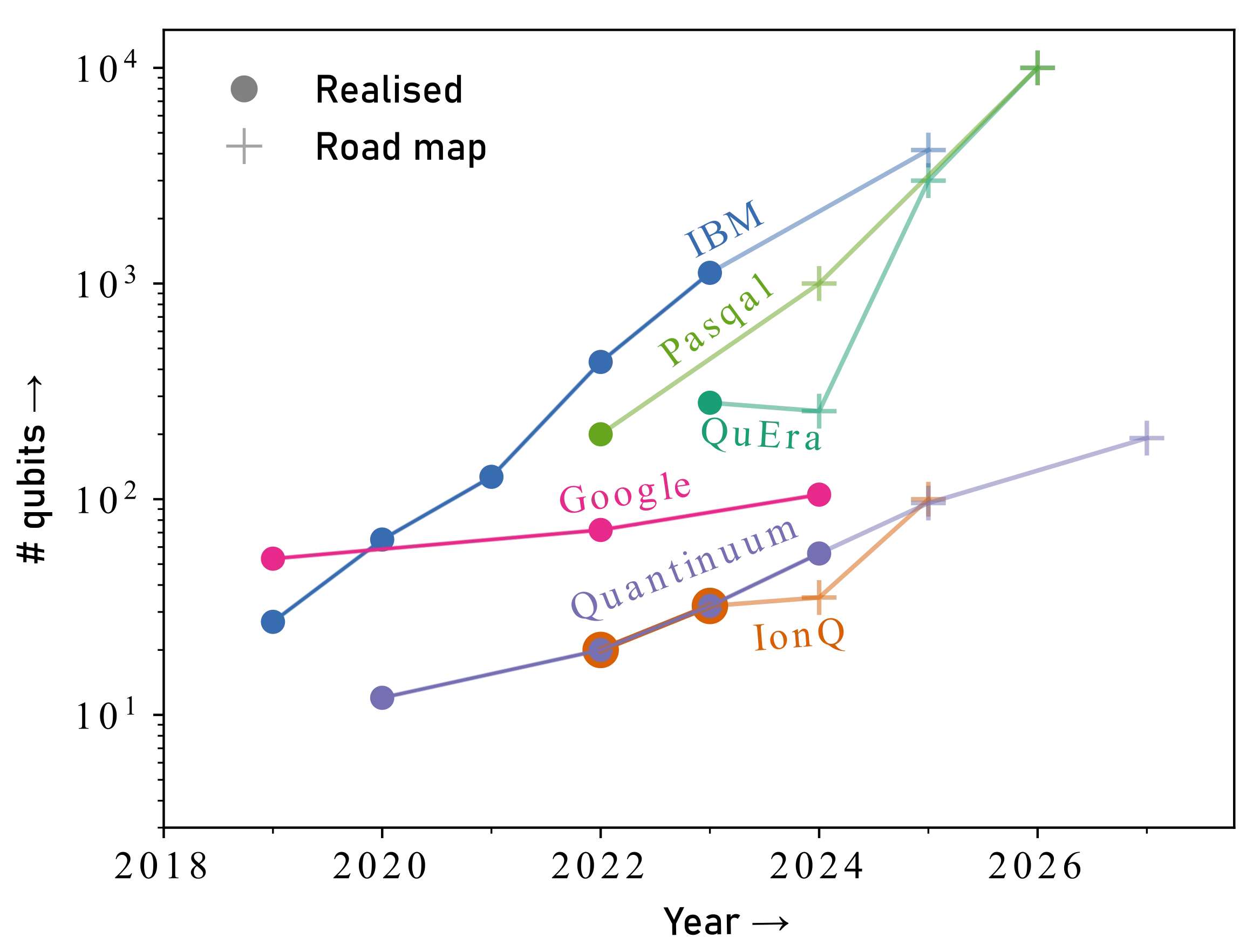
Image: Timeline of quantum computing eras up to 2025
But Wait… Why Aren’t We Using It Already?
Quantum computing is hard—like, really hard.
1. Fragile Qubits
Qubits can lose their “quantumness” in microseconds. This is called decoherence.
2. Error Correction
Because qubits are so fragile, computations need special tricks (called quantum error correction) to keep data reliable. This makes quantum computers 100x bigger and slower than they appear.
3. Scaling Up
Making a quantum computer with thousands of stable qubits is a massive engineering challenge.
What Does the Future Hold?
- Quantum Internet: Ultra-secure communication using entangled particles
- Post-Quantum Cryptography: New security that classical and quantum computers can't crack
- Hybrid Models: Quantum + Classical systems working together
In the next 5–10 years, we’ll likely see quantum computing as a service (QCaaS) used for very specific scientific and industrial tasks—not gaming or Word docs.
Want to Keep Up with Quantum (Without the Jargon)?
Subscribe to this blog for more explainers, tech trends, and breakthroughs simplified for curious minds.
If you enjoyed this post, share it with someone who thinks quantum physics is too complicated. You just proved it isn’t.
Further Reading
About the Author
Shreyansh Nahata is a tech enthusiast and writer who explains cutting-edge technologies in plain English. Follow for more posts simplifying AI, quantum, and future tech.
Comments
Post a Comment