The Quantum Leap: Understanding Quantum Computing and Its AI-Powered Future
The Quantum Leap: Understanding Quantum Computing and Its AI-Powered Future
Published by The Ultimate Techie
Quantum Computing Meets Artificial Intelligence
One of the most exciting frontiers of quantum computing is its intersection with Artificial Intelligence (AI). While today’s AI systems rely on large-scale data processing and pattern recognition through neural networks, quantum computing introduces a fundamentally different way to process and analyze data. This isn't just about speed—it’s about how data is understood and transformed. Quantum systems don’t just crunch numbers; they manipulate probabilities, enabling machines to explore many possibilities simultaneously.
For example, AI systems often require optimizing huge, high-dimensional spaces—something quantum computers might eventually perform more efficiently through quantum annealing or variational quantum algorithms. This opens up new avenues for Quantum Machine Learning (QML), a burgeoning field combining the mathematics of quantum mechanics with the logic of machine learning algorithms. QML models may one day outperform classical ones in tasks like classification, clustering, or generative modeling. Imagine neural networks where the nodes aren't just classical activations, but quantum states with phase, entanglement, and superposition properties!
Real-world experiments have already begun. Google’s Quantum AI lab has explored quantum-enhanced classifiers, while companies like Rigetti and Xanadu are working on building quantum-native models that integrate into TensorFlow or PennyLane workflows. These models are still in early stages, but early prototypes like quantum-enhanced support vector machines or quantum generative adversarial networks (QGANs) show promise.
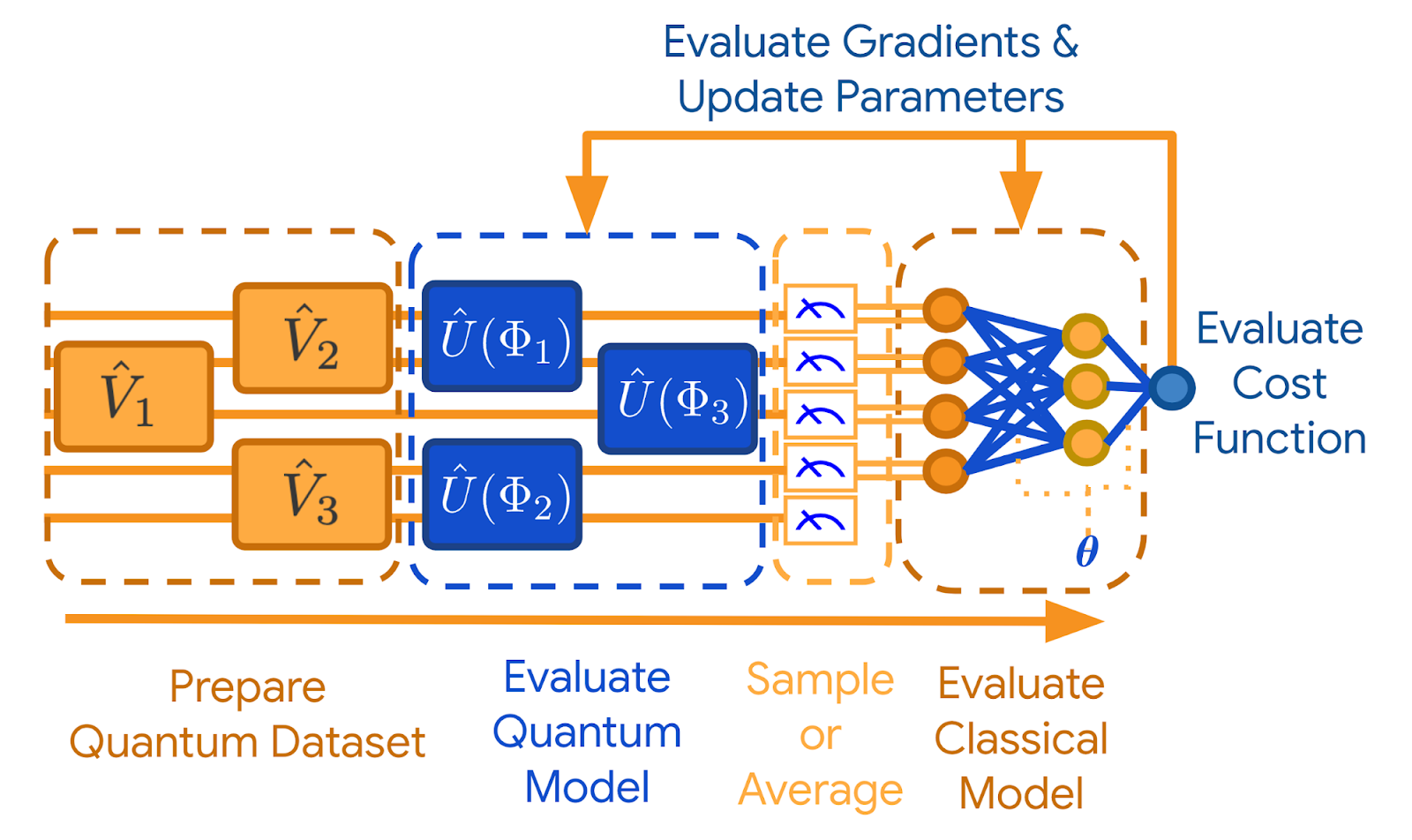
Image: Illustration of Quantum Machine Learning - blending AI with Qubits
But it’s not all smooth sailing. Quantum data is delicate, and quantum noise can overwhelm meaningful patterns. One of the challenges QML faces is data loading—transferring classical data to quantum states requires intricate encoding strategies, such as amplitude encoding or quantum random access memory (QRAM). These remain expensive and error-prone processes.
National Interests and the Global Quantum Race
Quantum computing isn’t just a technological endeavor—it’s also a geopolitical race. Leadership in quantum technologies means dominance in cybersecurity, advanced materials, pharmaceuticals, logistics optimization, and beyond. That’s why national investments are surging worldwide.
In 2018, the U.S. passed the National Quantum Initiative Act, earmarking over $1.2 billion in federal research across labs like IBM, Sandia, and NIST. The Department of Energy funds quantum testbeds and collaborates with top universities like MIT, Caltech, and Harvard. Meanwhile, China is playing an aggressive long game, having already demonstrated quantum satellite communications via Micius and laying down an intercity quantum communication backbone connecting Beijing and Shanghai.
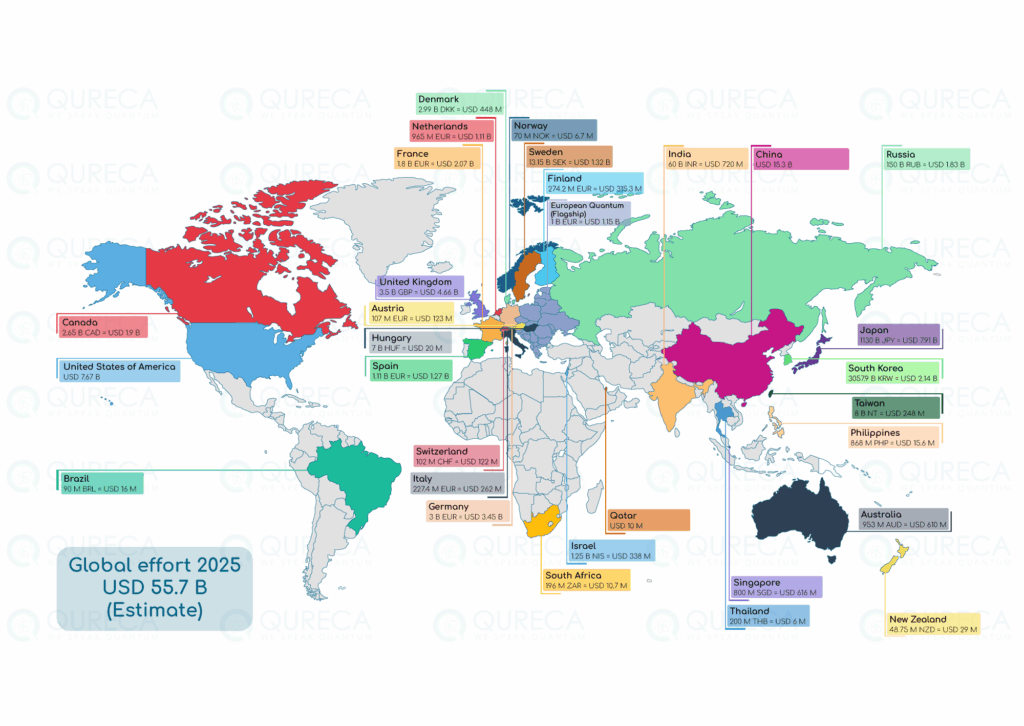
Image: Global quantum initiatives map 2025 – Qureca
Europe launched its Quantum Flagship program with €1 billion over 10 years, with contributions from companies like Airbus, Atos, and Thales. India, Japan, Canada, and Australia also have national missions with strong research-industry-academia collaborations. The diversity in quantum strategies reflects global priorities: while the U.S. and China lead on hardware, Europe and Canada lead on foundational theory, and countries like Singapore and Israel are innovating in security applications and cryptographic protocols.
Quantum Internet and Cryptography of the Future
Traditional encryption methods—RSA, ECC, even blockchain-based systems—rely on the computational difficulty of certain mathematical problems. But with quantum algorithms like Shor’s, these could be broken in polynomial time. That’s where Quantum Key Distribution (QKD) and quantum-safe cryptography come in.
QKD allows two parties to share a key by sending entangled photons through a quantum channel. If a third party attempts to eavesdrop, the quantum state collapses—instantly revealing the intrusion. The result: provably secure communication. This isn't theoretical; China’s Micius satellite has successfully demonstrated QKD over thousands of kilometers.
Image: CC BY 4.0 from Figshare
The quantum internet, when realized, could connect distant quantum computers and enable distributed quantum computing. It would not only change communication security but also how we think about cloud computing, authentication, and privacy at scale. DARPA, the European Quantum Communication Infrastructure initiative, and numerous commercial startups are building the components—quantum repeaters, teleportation protocols, and entanglement distribution networks—to make this a reality.
Ethical and Social Implications
With great power comes complex responsibility. Quantum computing could destabilize digital economies overnight if not managed with caution. Consider this: banks, governments, militaries—almost every digital infrastructure today relies on encryption methods vulnerable to future quantum attacks. The race isn’t just to build quantum computers but to upgrade our security before that happens.
Furthermore, accessibility and equity are key concerns. If only elite institutions or superpowers control quantum resources, the divide between tech-haves and have-nots will deepen. That’s why organizations like the Quantum Economic Development Consortium (QED-C) and Quantum Computing for Everyone (QC4E) are pushing for open-source tools, public cloud simulators, and accessible curricula.
Ethicists are also exploring how quantum algorithms might reinforce or eliminate biases in AI models, whether quantum simulation could accelerate weapons research, and how to create global governance frameworks that anticipate risks without stifling innovation.
Education and the Quantum Workforce
The greatest bottleneck to the quantum revolution isn’t hardware or software—it’s humans. Building and using quantum systems requires an interdisciplinary mindset. You don’t just need quantum physicists—you need engineers who can build stable systems, computer scientists who understand quantum logic, and mathematicians who design algorithms suited for quantum constraints.
Universities worldwide are waking up to this need. Institutions like MIT, Waterloo, TIFR, and ETH Zurich have launched quantum computing degrees or tracks. Companies like IBM and Microsoft offer free online training programs and Qiskit or Azure Quantum certifications. Nonprofits like QWorld, Qubit by Qubit, and QuSTEAM are also working to build inclusive, diverse quantum education pipelines.
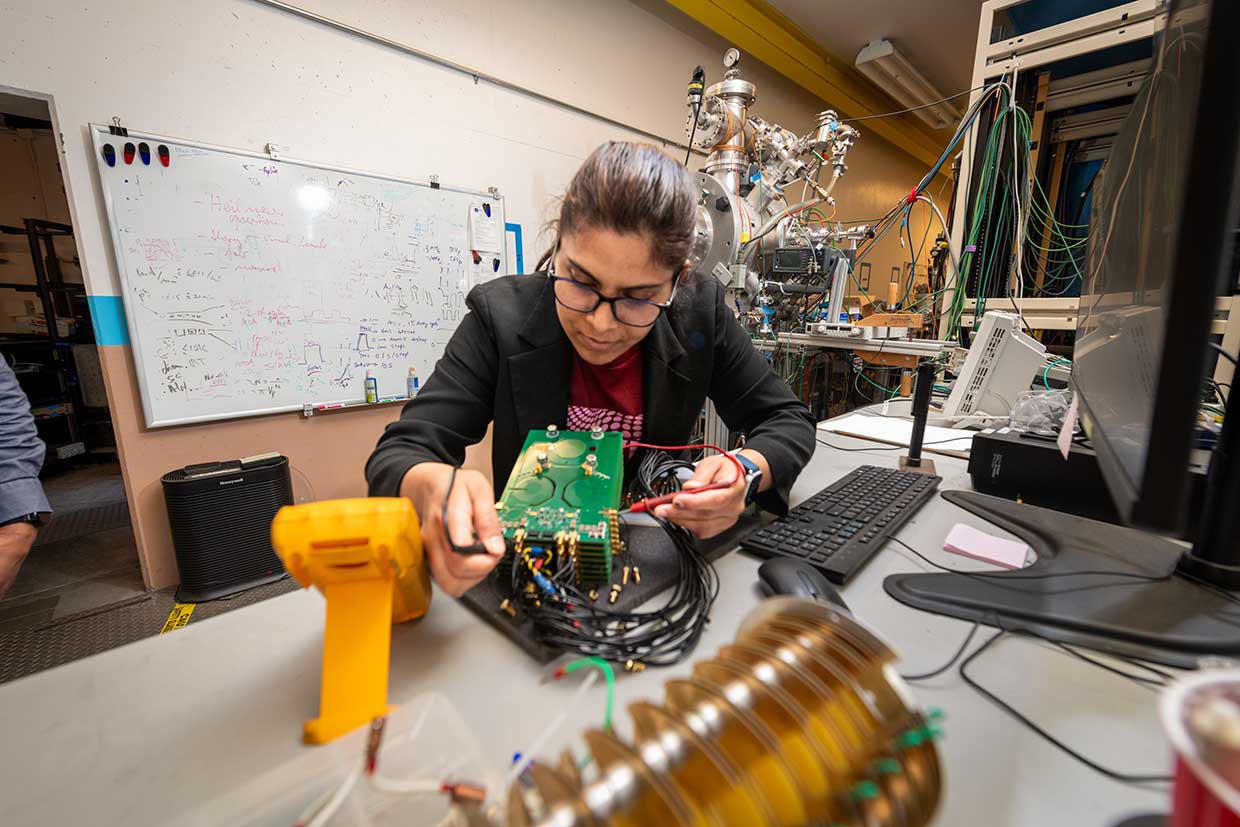
Image: Students learning quantum programming in university lab
The Future: When Will Quantum Computing Become Real?
This is the golden question. When will quantum computers leave the lab and enter our lives like smartphones or laptops? The consensus: we’re still in the Noisy Intermediate-Scale Quantum (NISQ) era. These machines are limited in qubit count and prone to errors—but they’re real, programmable, and usable for experimentation.
Companies like IBM, IonQ, and Quantinuum are offering quantum access via the cloud. You can literally run a quantum circuit from your browser. However, large-scale, fault-tolerant quantum computers—ones that can crack RSA or simulate protein folding—will need breakthroughs in error correction, cryogenics, and materials science.
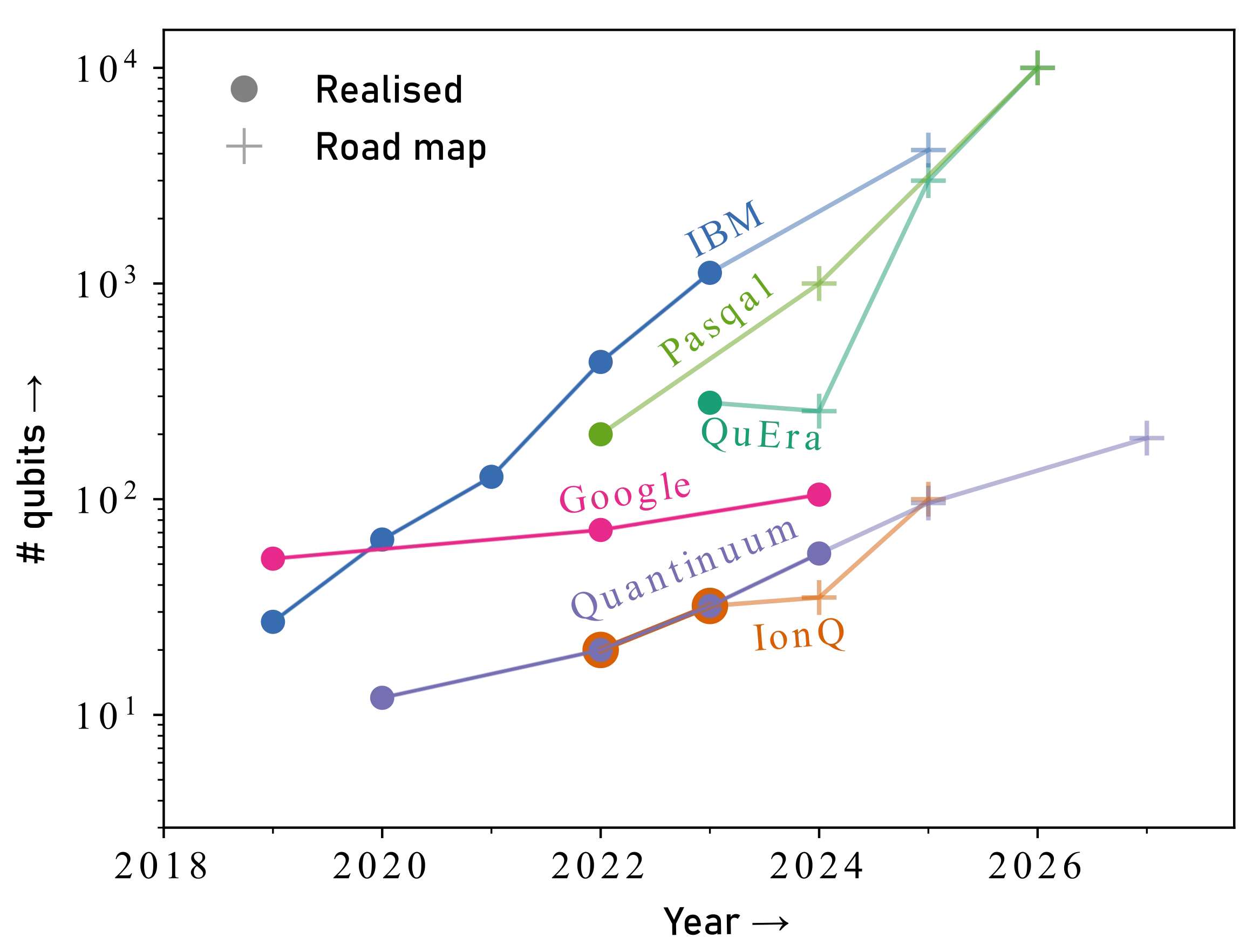
Image: Timeline of quantum computing eras up to 2025
Still, the progress is undeniable. Just like classical computing evolved from room-sized machines to chips in your smartwatch, quantum systems are on their own Moore’s Law-like trajectory. We may not get universal quantum supremacy soon, but sector-specific advances—in chemistry, finance, or logistics—are already within reach.
Final Thoughts
This article began with an exploration of qubits and their strange behavior. But as we’ve seen, quantum computing is not just a technical curiosity—it’s a full-stack revolution. From national security to AI transformation, from next-gen cryptography to ethical dilemmas, quantum touches every part of the future.
If you’ve stayed with me this far, thank you. Stay curious, keep reading, and watch this space—because the quantum world is only just beginning to unfold.
References
- IBM Quantum. Understanding Qubits and Quantum States.
- Peter Shor. Algorithms for Quantum Computation: Discrete Logarithms and Factoring, 1994.
- Google AI Blog. Quantum Supremacy Using a Programmable Superconducting Processor, 2019.
- Lov Grover. Quantum Mechanics Helps in Database Search, 1996.
- Nature. Experimental Realization of Shor's Algorithm.
- Rigetti Computing. Quantum Machine Learning Case Studies.
- NIST. Post-Quantum Cryptography Standards.
- China Academy of Sciences. Quantum Satellite Micius Launch.
- European Commission. Quantum Flagship Roadmap.
- National Quantum Initiative Act, USA, 2018.
Comments
Post a Comment